Wednesday, May 16, 2012

Posey’s Trail on Comb Ridge


Posey’s Trail is the maintained county road on top of the north section of Comb Ridge, west of Blanding in southeast Utah. From Blanding, heading west on Utah 95, turn north on the well marked Cottonwood Forest Road, and after 0.9 miles turn west.

The Posey’s Trail is marked as Road 240, and is 4.7 miles after the west turn. The unmarked trailhead for the Tower Ruin Trail is about 0.5 miles back east from Posey’s Trail.


After about 0:40 minutes of slow hiking the road passes very close to the west edge of Comb Ridge and there are spectacular views up and down Comb Wash. In mid May, there were many wildflowers in bloom in this area.

The road visible below leads from the Arch Canyon trailhead area and it is possible to hike to Posey’s Trail from there. The road that climbs up is too rough for most vehicles. Besides the views, there is some rock art and an arch along that route.


Visible to the west, sticking up from the mesa top area is Hotel Rock, a ruins site. There is a rough 4WD road leading there and it is  feasible to hike there. I scanned the side canyons below with binoculars but didn't notice any other ruins sites.


Arch Canyon is the major feature below. Walnut Knob is visible but is hard to pick out. 


After about 1:15 hours of hiking, about 2.5 miles, I came to an unexpected trail junction. The main trail continues south, maybe two more miles. The minor side trail leads east across the upper part of the west side canyon off of Butler Wash. On the other side, the trail then turns south. It looks like ATVs use this route and maybe horse riders.


Continuing south, there are a series of large alcoves across the canyon. I scanned this first group, and there might be some wall fragments visible. There are trails visible on the canyon bottom and along some of the ledges that lead to the alcoves. From where I was viewing, it was too steep to descend and approach these alcoves.
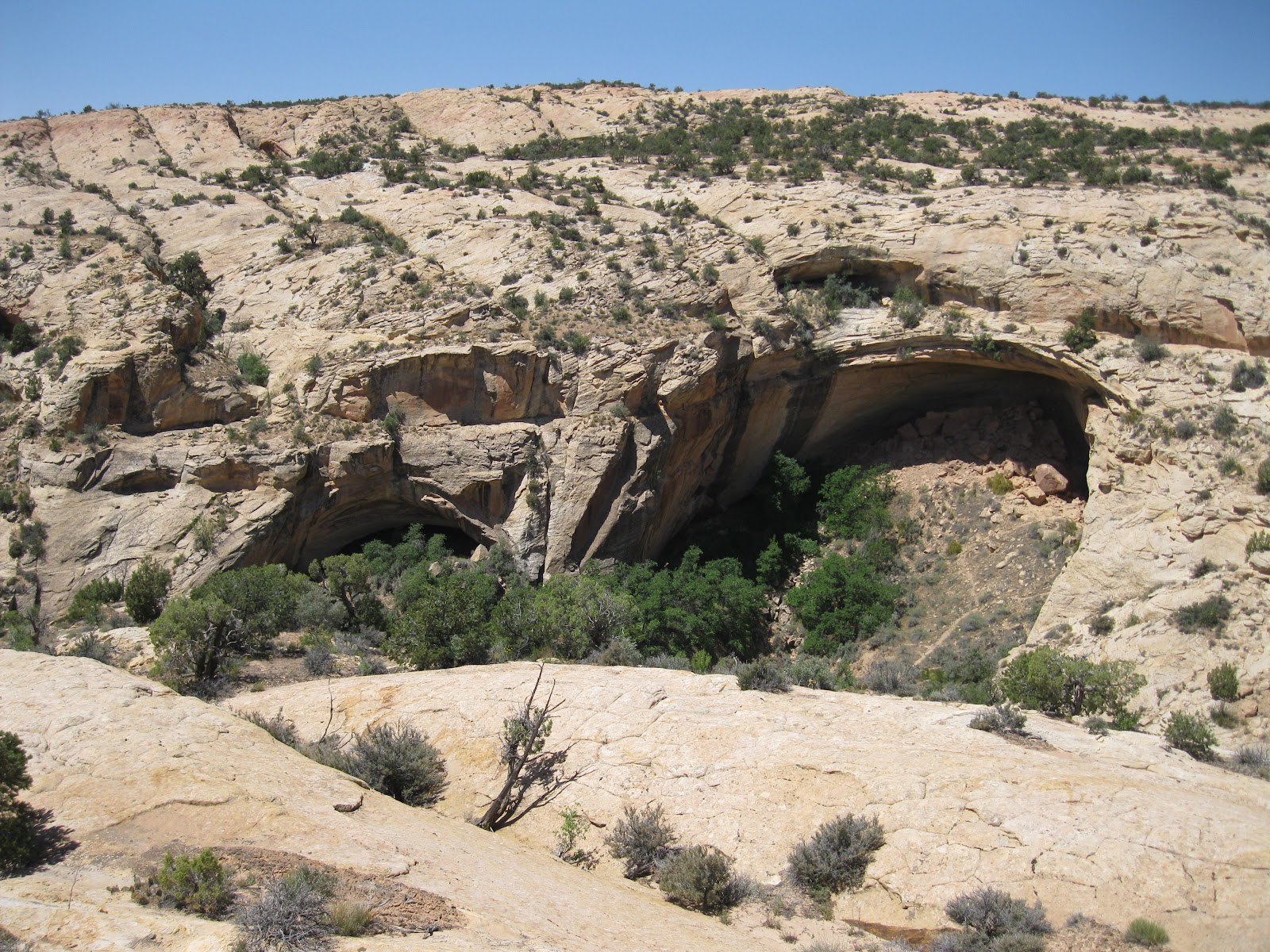

A second group of alcoves is a short distance further south. The largest alcove has a wall section visible in the shadows. There are trails visible here also. I didn't recognize this site at first, but this is the Ballroom Cave. From above, all the interior detail is invisible.


The view into a third group of alcoves is obscured by trees. I couldn’t see any structures along the edges where there is some visibility. But this is the Target Ruin site. This view shows the trail leading up to it from the main trail. The large visible alcove has some small structures and the Target site is just to the right, out of sight. The south end of Posey’s Trail should be in the area above these alcoves. 


I turned around here after 2:30 hours. This trail leads toward the Upper Butler Wash Trail but I don’t know where it connects.  My return hike took 2:30 hours for a total hike of 5:00 hours for about 8 miles. It was 60 F degrees at my 10:00 AM start and 78 F at the 3:00 PM finish. I carried and drank 3 liters of water.


Tuesday, May 15, 2012

Cedar Mesa May Wildflowers


Posey’s Trail on top of the north end of Comb Ridge in southeast Utah is known for the spectacular views overlooking Comb Wash and Arch Canyon, but in mid May there was also a very good display of the desert wildflowers.


The most noticeable flowering shrubs were the yellow flowers of Cliffrose in the Rose Family. These were very common along the road while traveling to the trailhead. The shrub to the left is the Roundleaf Buffaloberry in the Oleaster Family. The Roundleaf Buffaloberry is common in the Cedar Mesa area, but I don’t see it very much in other canyon areas of the Four Corners region.


I think this yellow tubular flower is in the Lithospermum genus of the Borage or Forget-Me-Not Family. There are several species in this group and they are commonly called Puccoons.


This four petaled white flower, along the sandy edges of the trail, looks like an Evening Primrose.


One of the most colorful flowers in the Four Corners is the Miribilis in the Four-O’clock Family.


I only saw one Sego Lilly or Mariposa Lilly growing along the trail.


There were many Prickly Pear Cacti along the way, but this was the best group with flowers.


Another colorful flower is the Indian Paintbrush in the Snapdragon Family. There are several species of these all around the Four Corners.


Both the Narrowleaf Yucca and Banana Leaf Yucca were in bloom in this area.


I thought this yellow flower resembled Prince’s Plume in the Mustard Family, but wasn't the best example. My hike was on May 14. This date is getting close the too warm part of the hiking season on Cedar Mesa and there were some of the dreaded June biting gnats out during the warm afternoon.

Tuesday, March 6, 2012

Comb Ridge North of Cold Spring Cave

The Cold Spring Cave Trail is one of the better known routes in the otherwise obscure Comb Ridge area, a few miles west of Bluff in southeast Utah. On this hike I was exploring the area just to the north of Cold Spring. I parked along the main Butler Wash Road 8.3 miles north of the south gate.


From this starting point there is an old fence where I found cow trails to follow toward and across Butler Wash. I was heading for the small canyon that is north of the large patch of desert vegetation that covers the lower slope of the otherwise bare Navajo sandstone of Comb Ridge. On a previous hike I had noticed a small storage sized structure from the rim overlooking this small canyon.


This small site appears to be very well preserved and is nicely protected in a small south facing alcove. The walk up this small canyon was easy and it took me about 0:40 minutes to arrive here. There is another alcove at the head of this canyon that had some piles of rocks but didn't appear to be a ruins site.


To the east of the well preserved ruin there is a rough constructed rock wall. There is a climbable slope on the north side of this canyon and I continued to hike north to the rim of the next canyon. I scanned the next canyon with binoculars but didn't notice anything, so I continued around the canyon head to the next rim. The sandstone rock surfaces are mostly smooth and easy to walk on.


I was surprised to find two large alcoves with ruins spaced a couple of hundred yards apart. This is a view of the more eastern of the two. There is a fairly easy ramp leading down directly across from this site. I was 1:25 hours into my hike when I enjoyed this spectacular view. I hadn't been aware that there were ruins here and it was exciting to find these two sites.


The eastern down canyon site has a small structure that appears to be dry wall without any mortar. On each side there are some low walls still standing. On a boulder in front there are some grinding grooves with some minor petroglyphs alongside the grooves.

The up canyon site has a larger alcove to work with and has a larger standing structure. In early spring the trail between the sites has several pothole pools of water to step around.

Part of the front wall has collapsed but otherwise most of the large room has held together well. I checked the canyon wall approaching the right side of the alcove but didn’t notice any rock art.


The alcove behind the structure has some water seeping through the rocks and some maidenhair fern is growing on the rock walls.

Although these two sites are probably not as well known as others in the Comb Ridge area, there is a trail leading to them up the canyon. I followed this trail down canyon and there is one major pour off to get past. There is a wide ledge on the north side of the canyon that provides a route. In this view I’m on the ledge looking back at the pour off.

Like most of the Comb Ridge trails, there aren't many markers showing the way. Past the pour off down canyon, there is another large alcove that didn't appear to have any structures but I noticed some faint mountain sheep petroglyphs on the right edge. Near the canyon mouth, there is a trail junction with a path leading to a north arm of this small canyon system.

This trail has a side road leading to it off of the main Butler Wash Road. It is about 9.3 miles north of the south gate and was about 1 mile north of where I started my hike. In early March it was about 45 F degrees at 10:45 AM and about 60 F degrees at 2:05 PM. My total hike took 3:20 hours for about 5 miles. I carried and drank 2 liters of water.


Tuesday, October 18, 2011

Road Canyon South Rim

The south rim of upper Road Canyon can be accessed along the Cigarette Springs Road. This bumpy road is one of the east turnoff, about 10 miles south of the Kane Gulch Ranger Station along Utah Route 261 in the Cedar Mesa area of southeast Utah.

About 6 miles east there is a north turnoff that leads about 0.8 miles to the Road Canyon south rim. At the rim there is a route that descends into the canyon and a trail both east and west along the rim. I followed the rim trail east. Road Canyon is deep and layered as it meanders toward the east. With binoculars, there may be small Ancestral Pueblo ruins sites visible across the canyon.

The trail is easy to follow along the dirt segments and has rock cairns marking the way on the bare sandstone segments. After about 2 miles, there is a peninsula extending out into the twisting canyon. Just before the peninsula, there is a rocky outcrop with several large potholes that were holding pools of water.

The trail descends, with some rock scrambling, about 30 feet on the west side to a ledge and then crosses above the neck of the peninsula. There is more scrambling with a looping descent down the sloping sandstone before reaching the level of the narrow neck that leads to the large outcrop at the tip. This segment is somewhat exposed but is marked with cairns.

On the south side of the large boulder formation at several well preserved rooms. Sometimes these large boulder based sites have rooms on the boulder top, but there is no sign of that here. I didn’t see any kivas or rubble pile structures in the level area below these rooms. This doesn’t appear to be a village. Not very many people could live here and it looks like there isn’t much winter shelter.


These rooms don’t have a view toward the approach along the peninsula. One room has a good view down the canyon. 

Sleeping Ute Mountain, Mesa Verde, and the LaPlata Mountains are visible in the far distance, about 100 miles away.

One of the rooms has what appears to be a small window. Many of these structures have small openings in addition to the doorways, but an intermediate size opening like this seems unusual. There was a small display of artifacts here.
There are two low walls along the walkway out to the rocky peninsula. If these were for defense, they don’t seem to be much of a barrier compared to the rocky ledges that come before. My total hike took 4:00 hours on a 64 F windy mid October day. I carried and drank 3 liters of water. I saw 4 other hikers and 4 dogs during my hike.

532497_120 x 90 Starting Salary $42k. Group 1
528614_Russell Outdoor Logo 125x125 18407_$5 Shipping on Orders of $99 or More!

Wednesday, October 12, 2011

Lower Snow Flats Road and Mormon Trail

The lower end of the Snow Flats Road begins about 2 miles north of the south end of the Comb Wash Road. The south end of the Comb Wash Road is a north turn off of Highway 163 about 8 miles west of Bluff in southeast Utah.

There is a junction where the Snow Flats Road splits from the Comb Wash Road with Snow Flats branching off to the left. It is marked as County Road 237 and there are also the covered wagon symbols of the Mormon Trail. About 3 miles past this junction, there is an information kiosk.

This route has some bumpy eroded spots where it crosses the small washes. There is a sign reminding visitors that a special permit is now required to visit the Moon House ruins site. I think that from where I started hiking, it is at least 10 miles to Moon House. Hiking in this area has good views of the west side of Comb Ridge and is historic.


I started hiking at the information kiosk that is 5 miles north of the junction with Highway 163. The Snow Flats Road turns northwest and starts to climb. The vegetation close to the Comb Wash is mostly Greasewood and Three Winged Saltbush. As the road climbs, the vegetation changes to Blackbrush and Mormon Tea with Cliff Rose, Narrowleaf Yucca, Indian Rice Grass and a few Utah Junipers.


About 2 miles past the information kiosk, there is a short side road that leads to a south overlook over the lower part of Road Canyon. There was a trail leading down from the overlook and it looked like this was a route to the canyon floor.

I followed the trail down a short distance, but on this hike I wanted to explore along the road. I spent about 30 minutes looking around this rim area but didn’t notice any Ancestral Pueblo ruins sites. Continuing on, there is an entrance sign for the Road Canyon Wilderness Sturdy Area.


After 2:20 hours of hiking and about 4 miles, I stopped and climbed a low hilltop that had good 360 degree views. It looked like there is a survey monument on top of this hill. The Snow Flats Road continues across a level area for about 1.5 miles before reaching the distant cliffs. The road on the section I hiked was in good condition.

The return hike shows the views of the massive barrier that the Mormon pioneers faced as they descended off of Cedar Mesa. In 1879-1880, 200 people with 83 wagons, several hundred horses and 1000 cattle descended this way. There aren’t any interpretive signs along this section of trail. On the rough road that continues south of Highway 163 there are several signs pointing out the places where the pioneers were eventually able to cross Comb Ridge. In Bluff, the Fort Bluff site has been developed into an interesting historical site.


When viewing Comb Ridge from the east side, the pinkish Navajo Sandstone is mostly visible. From the west side, this appears to be the cliffs of the Wingate Sandstone sitting on the shales and mudstones of the Chinle layer. The ledgy Kayenta layer above the Wingate seems to be present most of the way with a few glimpses of the Navajo sandstone. This section of Comb Ridge just east of the Snow Flats Road, where the Navajo sandstone is visible, is the area where the Procession Panel is located.


My total hike took 4:00 hours for 8 or 9 miles. I carried and drank 3 liters of water on a 65 F degree mid October day. I didn’t see any vehicles on the Snow Flats road during my hike. There was one vehicle that appeared to be camping.


 528614_Cool Camo Russell Outdoors